Wednesday, May 20, 2015

Sitting still

For me, birding involves tramping all over the place, most of the time. Visit a lot of different locations, see a lot of different birds. Sometimes, though, it's better to sit and wait.

I hadn't seen a Bay-Breasted Warbler this Spring. There had been plenty of sightings, but by the time I got there, the birds were gone. Saturday, I took a rest on a bench at Azalea Pond. Eventually, there was some movement across the pond, up high. A pair of Bay-Breasteds, males it looked like. At last!

I continued resting. One of the birds came down to the tree in front of me and grabbed some lunch.

Ed Gaillard: birds &emdash; Bay-Breasted Warbler at luncheon
Bay-Breasted Warbler at luncheon

How about that? Best view of a Bay-Breasted Warbler I ever had. He hung around a few minutes, singing and preening.

Ed Gaillard: birds &emdash; Bay-Breasted Warbler, Azalea Pond
indeed, I am a fine-lookin' bird

Sunday, I was intending to walk up to the North Woods (Central Park), starting at West 81st Street, but I wasn't really sure I was up to it. I git into the park, and at the bottom of the path going up Summit Rock, I had a nice view of a Redstart.

Ed Gaillard: birds &emdash; American Redstart
a bird with an idea

And then a White-Crowned Sparrow came out, right on the path.

Ed Gaillard: birds &emdash; White-Crowned Sparrow
elegant sparrow

He flushed into the bushes whenever someone walked down the hill, but always came back right after.

Then I sat down for a long time at Tanner's Spring. The "spring" is often just a mud puddle, but this day the water was pretty high from the rain the previous night. A lot of birds came down to enjoy it. There was even a Nashville Warbler!

Ed Gaillard: birds &emdash; Nashville Warbler, Tanner's Spring
unusually good view of a Nashville

There was a Magnolia Warbler there who seemed to have an unusual amount of testosterone. Not only was he singing, but he was chasing other birds around. I watched him chase a Black-and-White Warbler away from the water several times, and he even want after House Sparrows.

Ed Gaillard: birds &emdash; Magnolia Warbler, Tanner's Spring
mighty bull warbler

The AIDS walk, going on that day, passed on the drive only a few dozen yards away. They had brass and percussion bands, but the birds didn't seem bothered at all. I watched this Northern Waterthrush calmly work his way around and around the spring while the drums pounded.

Ed Gaillard: birds &emdash; Northern Waterthrush, Tanner's Spring
cool and collected

All in all, a good weekend for sitting and watching.

Wednesday, May 13, 2015

Surprises

There are always surprises. On Monday, a Marsh Wren popped up in Bryant Park. He (the bird was reported singing a few times) was a lot more accessible than his species usually is. I suppose he didn't have much choice--there's not that much room to hide there.

Ed Gaillard: birds &emdash; Marsh Wren, Bryant Park
uncharacteristically sassy

The wren was in the southwest corner, next to the guard booth. He was there yesterday as well, but I haven't seen any reports from today.

After a few slow days, Tuesday was pretty busy in Central Park. On my way through in the morning, there was a commotion of birds bathing and drinking at the stretch of slow water just north of Azalea Pond. Several warblers buzzed around, including Yellow-Rumped, Black-and-White, female Black-Throated Green and Blackpoll, and a very drab one I couldn't identify. I got a bunch of photos of it and moved on.

Fifty feet on, I saw movement up in a tree. The bird seemed large but well-hidden--and then it came out.

Ed Gaillard: birds &emdash; Black-Billed Cuckoo, Central Park
"I'm ready for my screen-test"

A Black-Billed Cuckoo! I'd missed this species so far this Spring, despite it being reported more frequently than usual. But there it was, posing nicely. I got a few passing birders onto it, and then a bunch more showed up when I tweeted the sighting. (Reminder: a lot of good birds in Manhattan are reported on the Twitter hashtag #birdcp. There's a description of the system on David Barrett's website at https://bigmanhattanyear.wordpress.com/using-birdcp-text-alerts/)

On the way out of the Ramble, I saw my first Chestnut-Sided Warblers of the Spring. About time, too.

Then, on the subway to work, I took a look through my photos. That drab warbler? Wasn't a warbler.

Ed Gaillard: birds &emdash; Philadelphia Vireo, Central Park
got to be good-looking 'cause you're so hard to see

Philadelphia Vireo! Not a frequently-seen bird around here, and when we have it it's usually in the Fall. And they usually stay up pretty high and well back in the leaves, so this is by far the best view I've ever had of a Philadelphia. It simply never entered my mind that one would be around, so I didn't recognize it while I was looking at it.

During the day, people found an Olive-Sided Flycatcher in the Ramble. That's not as infrequent a visitor as the Vireo, and we regularly get one at the same location every May about this time. I'm convinced it's the same bird every year.

*Ed Gaillard: birds &emdash; Olive-Sided Flycatcher, Azalea Pond
his favorite place for dinner when passing through the City

It likes the top of a tall mostly-bare tree just at the northwest corner of Azalea Pond. It's a good perch for an Olive-Sided, and there's lots of larger insects around. The bird will sally and return to the perch over and over, pausing in between to eat its catch. And that's where I found it in the good late-afternoon light.

This Olive-Sided comes back in mid-August, usually just a little earlier than returning birds of that species are expected. This has gone on for some years now.

This morning, I saw my first Pewees of the season. That leaves Great Blue Heron as the most common bird I haven't seen this year. That's a surprise, too--I've usually seen several by this point in the year.

Ed Gaillard: recent &emdash; Great Blue Heron, Turtle Pond
have you seen me?

Tuesday, May 12, 2015

Big weekend

I started my weekend by taking Friday off from work. There had been a lot of rarities reported in Central Park on Thursday--Blue Grosbeak, Red-Headed Woodpecker, both kinds of Cuckoo--but I was responsible adult and went to work.

They were all gone Friday, but I quietly got a total of 49 species anyway. A lot of migrating warblers were in.

Ed Gaillard: birds &emdash; Black-Throated Blue Warbler
I'm on my way

And a lot of resident birds were going about their business--establishing territory

Ed Gaillard: birds &emdash; Carolina Wren singing
I am wren, hear me roar

bathing

Ed Gaillard: birds &emdash; Orchard Oriole bathing with a Yellow-Rumped Warbler
Orchard Oriole and a Yellow-Rumped Warbler at the bird spa

and foraging.

Ed Gaillard: birds &emdash; Robin and apple
yum!

It was a splendid day. I had 46 species by noon, and then went off to look for the Mourning Warbler seen between Balcony Bridge and Triplets Bridge. I found it--along with dozens of other people--and had some good views, but I spent the rest of the day trying to get a good photo of it. It was too wily for me, though.

Saturday was the Global Big Day, organized by the Cornell Ornithology Lab as a conservation-awareness and fundraising initiative. The idea was to get a lot of people out in the field and see how many species they could see. The Lab hoped to record 4500 of the 10000+ species--they got almost 6000.

But it was a bit slow in New York. I had only twenty species in the Ramble, so I went up to Inwood Hill Park. The tide was rushing in when I arrived, but I was lucky enough to see the previously-reported Greater Yellowlegs

Ed Gaillard: birds &emdash; Greater Yellowlegs, Spuyten Duyvil Creek
skinny legs and all

which was a life New York City bird for me, and as a bonus there were a pair of Snowy Egrets--

Ed Gaillard: birds &emdash; Snowy Egrets, Spuyten Duyvil Creek
Egrets, I've had a few

--first of the year for me, and a very good bird for Inwood Hill.

Since I was there, I decide to look for the Wild Turkey that had been reported recently, and on the way up the hill I met Nadir Sourigi, a really fine birder who leads walks for Audubon and so on, and we went off to look for her and for Cuckoos. No luck on either, but I highly recommend the experience of birding with someone who's massively better than you. Great fun, as well as instructive and informative.

Sunday was a little brisker in Central Park, and a lovely day for birding as well.

Ed Gaillard: birds &emdash; Northern Parula
Northern Parula

Ed Gaillard: birds &emdash; Blue-Headed Vireo
Blue-Headed Vireo

I'll post more soon.

Monday, May 4, 2015

A delicious birding Sunday

Sunday unexpectedly turned into one of those rare days of Spring migration where you see amazing things. I hadn't been expecting much--very light winds had kept migration numbers down for several days--and the morning started with an uneventful stroll along the south side of Turtle Pond to Belvedere Castle. But when I descended into the Ramble, I found a hundred or more birders between the Humming Tombstone and the west side of Tupelo Meadow, all staring high into the trees.

In the next half-hour or so, I saw (and heard singing) a White-Eyed Vireo

Ed Gaillard: birds &emdash; White-Eyed Vireo, Central Park
White-Eyed Vireo

and also a singing Yellow-Throated Vireo--and both of those species can be hard to get in New York City--

Ed Gaillard: birds &emdash; Yellow-Throated Vireo, Central Park
Yellow-Throated Vireo

and several Warblers, including Black-Throated Blue, Black-and-White, and Nashville.

Ed Gaillard: birds &emdash; Nashville Warbler, Central Park
Nashville Warbler

Nashville Warblers aren't rare, exactly, but aren't all that easy to find.

I took a little break on a bench south of Tupelo Meadow, and watched a Titmouse and a Brown-Headed Cowbird poking around a mud puddle. On a snag above the puddle, a male Downy Woodpecker was digging out a nest-hole, sawdust flying everywhere. Then the female of the pair came around and I got to see them mating, which (like everything else about Downys) was adorable.

Out on the Point I saw my first-of-season Blackpoll Warbler--a bit early for them--and another White-Eyed Vireo, this one extremely confiding, spending several minutes at about eye level only a few feet from the path.

A couple of good birds had left the Tupelo frenzy before I got there--Blue-Winged Warbler and Blackburnian Warbler. Someone told me that a Blue-Winged was near the Rustic Shelter, and I eventually found it there.

Ed Gaillard: birds &emdash; Blue-Winged Warbler, Central Park
Blue-Winged Warbler

My first Common Yellowthroat of the season was there as well--a little late for a first sighting of that warbler.

A couple of rumors of the Blackburnian didn't pan out, and in mid-afternoon I was sitting on a bench at Evodia, watching the feeders and chatting with other birders. Adrian Burke's phone buzzed with an alert. "Blackburnian now in pine south side of Turtle Pond", he read out. "OK, see you all later." He left, followed closely by several of us.

Ed Gaillard: birds &emdash; Blackburnian Warbler, Central Park
Blackburnian Wabler

The flame-throat was indeed there, and Adrian did a great job getting everyone on the bird. The cherry on top of the birding Sunday was when he spotted a Red-Breasted Nuthatch going through the trees. That's shockingly late, like six weeks late, for a Red-Breasted to be hanging around this far south, but the bird's head pattern (black line through the eye, and while stripe over it) was unmistakable.

The nuthatch disappeared to the east very quickly; I think I was the only other birder who got a look at it. Normally I'd have followed it to try to get a better look and a photo, but I was so transfixed by the Blackburnian that I didn't.

Wednesday, April 29, 2015

Controversial Prothonotary

Monday afternoon a Prothonotary Warbler was reported in Central Park around Turtle Pond. I got there towards evening and didn't see it, but on Tuesday morning it was hawking insects off the Turtle Pond dock and bouncing around the low vegetation on the west side of the pond in all his egg-yolk yellow glory.

Ed Gaillard: birds &emdash; Prothonotary Warbler, Central Park
confiding Prothonotary

I've never had such a view. The Prothonotaries I've seen before were all 'way up in the treetops.

Anyway, this bird is slightly controversial, because it was just released by the Wild Bird Fund after they rehabbed it. (It had been found in the west 50s.)

So, why is that controversial? Well, for people who are competitive bird-listers, it makes a difference. You're not supposed to count a bird that got where it was with human aid--such as being recently released--according to the governing body for such things, the American Birding Assocaition (ABA). "Recently" is a little vague, and one well-known NYC birder quoted American Birding Association regulations in his report:

I claim that this is an ABA-countable bird. Recording rule 3B says that rehabbed birds are wild birds even though they have been transported. The reason this bird also passes rule 3C (and why last week''s Virginia Rail did not) is that the bird was no longer in its initial movement away from the release point. It had flown over 400 meters to the SE shore of Turtle Pond. It was actively feeding, flying across the pond several times.

There are rules, people, rules. Ahem. Sorry, I don't mean to mock, but this is the kind of thing that keeps me at some distance from the American Birding Association. Let me make it clear that I don't care what birds anyone else counts. I keep lists, but I'm not competitive. For me, if I had seen it on Monday evening, I would have put it in my eBird list, but I'd have a mental reservation about whether I'd "really" seen that species this year. But seeing the bird the day after the release, after it's had a chance to fly out, is perfectly fine to count. Somehow. By my own rules. Anyway, the Prothonotary is my 113th species of the year.

Many warblers are starting to come in. I've seen Black-Throated Green Warblers, some heard singing, and Black-Throated Blues, Common Yellowthroats, and Ovenbirds have been reported in the park, along with lingering Pine Warblers, both Waterthrush species, and a steady stream of Palm, Black-and-White, and Yellow-Rumped Warblers.

Ed Gaillard: birds &emdash; Yellow-Rumped Warbler, Central Park
butter-butt

Monday, April 27, 2015

Domestic arrangements

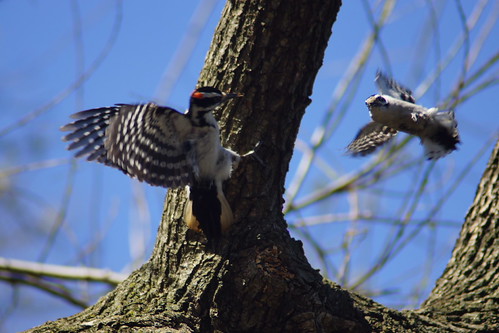
While Spring migration is in full swing, some birds are settling in for nesting season...or trying to. At Turtle Pond in Central Park, a pair of Downy Woodpeckers are excavating a nest hole in a willow tree. Saturday, we saw a Hairy Woodpecker come around...and the Downys chased him away. Elena got a photo of the action.

Downy vs Hairy
Woodpecker dispute (Photo by Elena Gaillard)

Meanwhile, on the pond's shore directly below, a pair of Mallards was browsing. A second male flew in--and then scooted right back out. The male of the pair chased the interloper all around the pond, hanging onto his tail.

Ed Gaillard: birds &emdash; Duck duel
take that, you bounder!

Things were a little calmer away from the water. Singing was everywhere, as males advertised for mates. Passing migrants sang:

Ed Gaillard: birds &emdash; Pine Warbler singing, Central Park
it's been a great Spring for Pine Warblers in the Park.

Resident birds sang as well, some not so musically,

Ed Gaillard: birds &emdash; Red-Winged Blackbird singing, Azalea Pond
whaddaya mean? I sound great!

while others seemed possessed by the spirit of Al Jolson.

Ed Gaillard: birds &emdash; Starling singing, Central Park
I'd walk a million miles for one of your smiles

Sunday, April 19, 2015

Right back at you

The pace of migration is picking up. In Central Park, many Pine, Palm, and Yellow-Rumped Warblers continue, some singing. There's been some reports of Blue-headed Vireos, and I saw my first Black-and-White Warbler on Sunday. The day's highlight, though, was this very late Pine Siskin at the Evodia feeders.

Ed Gaillard: birds &emdash; Pine Sisking, Evodia,  Central Park

With the warming weather, the birds are all quite busy, and I've gotten very good looks at some. This White-Breasted Nuthatch has been around Laupot Bridge all winter, and still seems to have a lot of food stashed in the bridge posts.

Ed Gaillard: birds &emdash; White-Breasted Nuthatch, Laupot Bridge

He was making curious little grumbling sounds as he worked around the area, on occasionally giving out the typical brash "henk! henk!" call Nuthatches are known for.

The cardinals in Central Park tend to be quite tame, and will often get up close to people, like this one:

Ed Gaillard: birds &emdash; Northern Cardinal, Central Park

And why not? People sometimes have peanuts and stuff.

Nesting season is already starting for some resident birds. I've seen some Robins on nests, and others gathering nesting material.

Ed Gaillard: birds &emdash; American Robin with nesting material, Central Park

Cardinals and Grackles have been carrying around nesting material as well.

I've seen all three of the common swallow species (Barn, Tree, and Northern Rough-Winged) at Turtle Pond in the last week, and a bunch of cormorants has been hanging out there as well.

Ed Gaillard: birds &emdash; Double-Crested Cormorant, Turtle Pond

Sometimes you can see why the Cormorant is called the devil's bird.

Some species have already passed through. The Fox Sparrows are gone. and the bulk of the Song Sparrows and Juncos as well. White-Throated Sparrows are still plentiful at the moment.

Ed Gaillard: birds &emdash; White-Throated Sparrow, Central Park

They'll be moving on soon, but I'm enjoying them while they're still here.